Your MKV file plays perfectly on your computer. Then you try uploading it to YouTube, sending it to a client, or playing it on your iPhone — and nothing works. The platform rejects it. The phone can’t open it. The editing software stutters.
Whether converting is actually worth it depends entirely on what you’re about to lose and what you’re about to gain — and most guides skip that calculation. AhaConvert makes the conversion itself painless, but the decision of whether to convert at all comes first.
MKV and MP4 Are Containers, Not Quality Levels
Before deciding anything, understand this: MKV and MP4 are containers, not codecs. They’re the box, not what’s inside it.
An MKV file and an MP4 file both containing H.264 video at identical bitrates look exactly the same. Quality comes from the codec and bitrate — not the container label. So “is it worth converting” is never really a quality question. It’s a compatibility-versus-features trade-off.
What You Gain by Converting
MP4 was built for compatibility. Nearly every device, browser, platform, and app on earth plays MP4 natively — iPhone, Android, smart TV, YouTube, Instagram, Zoom, Teams. That universal support is exactly what MKV lacks.
Convert if you need:
- To upload to YouTube, Instagram, or any social platform (MKV is rejected outright)
- Native playback on iPhone or Android without installing VLC
- Smooth performance in editing software that handles MP4 more reliably
- A file you can send to a client or colleague without explaining what a codec is
What You Lose by Converting
This is the part most guides leave out, and it’s the actual answer to “is it worth it.”
MKV (Matroska Video), launched in 2002 as a royalty-free open container, holds more than MP4 ever will:
- Unlimited video, audio, and subtitle tracks in one file
- Chapter markers with named navigation points
- Soft subtitles in multiple formats — SRT, ASS, SSA, PGS, VobSub — switchable on/off during playback
- Full HDR metadata for Dolby Vision and HDR10+ content
- Any codec: H.264, H.265/HEVC, AV1, VP9
A single Blu-ray backup MKV might contain 4K HEVC video, English Dolby Atmos audio, three dubbed languages, English SDH subtitles, director commentary, and 28 chapter markers — all in one file. MP4 handles maybe three of those things gracefully. Convert it, and you typically keep one audio track and one subtitle track at most.
Don’t convert if:
- You’re using Plex, Kodi, or Jellyfin — these handle MKV natively and preserve every subtitle and audio option
- You’re storing anime or foreign films — MKV’s ASS/SSA subtitle format supports styled, timed subtitles with custom fonts; converting often strips these into burned-in subtitles with no toggle option
- You’re archiving a 4K HDR Blu-ray rip — the Dolby Atmos audio and multiple subtitle tracks can’t be fully replicated in MP4 without losing at least one element
The Decision That Actually Matters: Remux vs Re-encode
If you do decide it’s worth converting, this single distinction determines whether you lose anything at all.
Remuxing moves the video and audio streams from MKV into an MP4 container with zero re-encoding. No quality loss. Takes seconds. Works when the video codec is H.264 or H.265 and audio is AAC or MP3.
Re-encoding decodes and recompresses the video from scratch. Some quality loss is inevitable, though minimal at high bitrate. Required when video uses VP9 or AV1, or audio uses DTS or Dolby TrueHD — formats MP4 doesn’t support.
Check first: open your MKV in MediaInfo (free). H.264/H.265 video with AAC audio means you can remux. VP9, AV1, DTS, or TrueHD means you’ll need to re-encode — and that’s a stronger reason to ask whether converting is worth it at all.
How to Convert (When It’s Worth It)
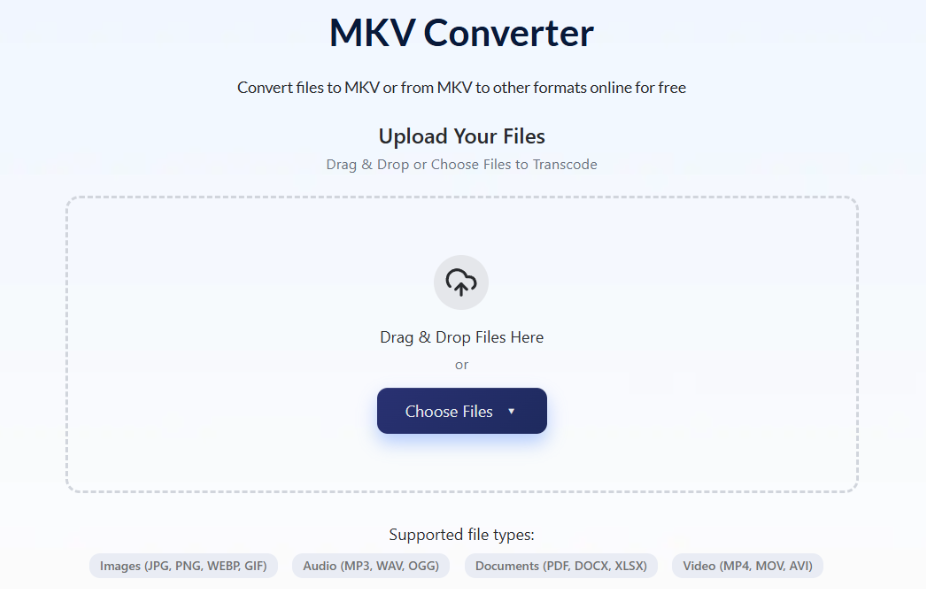
- Open AhaConvert’s free online MKV Converter
- Upload your MKV file from your device or paste a URL
- Select MP4 as output format
- Choose H.264 + AAC for maximum device compatibility
- Select which audio and subtitle track to keep if your MKV has multiple options
- Click Convert and download
AhaConvert automatically detects whether remuxing is possible and takes the lossless path when it is — no codec knowledge required. Files are protected with 256-bit SSL encryption, deleted within 24 hours, and no account is needed.
| Destination | Codec | Bitrate | Audio |
|---|---|---|---|
| General playback | H.264 | 8,000 kbps | AAC 192kbps |
| YouTube/Vimeo | H.264 | 10,000 kbps | AAC 192kbps |
| iPhone/Android | H.264 | 5,000 kbps | AAC 192kbps |
| Long-term archive | H.265 | 8,000 kbps | AAC 192kbps |
Frequently Asked Questions
Is it worth converting MKV to MP4 for personal storage?
Usually not, if your media player (Plex, Kodi, VLC) already handles MKV well. You’d be trading subtitle flexibility and multi-audio support for no real benefit, since playback already works.
Is it worth converting MKV to MP4 for sharing or uploading?
Yes, almost always. MP4’s universal compatibility outweighs the features you lose, especially since most shared content doesn’t need multiple subtitle tracks or 7.1 audio anyway.
Does converting MKV to MP4 reduce quality?
Not if your MKV contains H.264 or H.265 video with AAC audio — AhaConvert remuxes it with zero re-encoding. If re-encoding is required, quality loss is minimal at 8,000+ kbps but not zero.
Will converting strip my subtitles?
Often, yes — this is the most common reason people regret converting. MKV stores subtitles as separate switchable tracks; MP4 supports far fewer formats. AhaConvert lets you choose which track to embed, but verify the result before deleting your original MKV.
Is AhaConvert free to use?
Yes — completely free, no account required. Upload, convert, download. Files are encrypted during transfer and deleted automatically within 24 hours.
The Bottom Line
Converting MKV to MP4 is worth it when compatibility is the actual blocker — uploading, mobile playback, or client delivery. It’s not worth it when your current setup already plays MKV fine and converting would cost you subtitles, audio tracks, or HDR metadata you actually use.
When it is worth it, use the MKV Converter on AhaConvert and let it pick the fastest, highest-quality path automatically.