
Faith in the Bible Meaning is something I often find myself reflecting on, especially when life feels uncertain or overwhelming. If you’re here, you’re probably searching for more than just a definition you want clarity, purpose, and maybe even a little peace.
I write for readers like you who genuinely want to understand what the Bible teaches and how it applies to real life today. So, what does faith truly mean in a biblical sense? Is it just belief, or something deeper?
In this article, I’ll walk you through its powerful meaning in a simple, relatable way that speaks directly to your heart and daily journey.
Biblical Meaning of Faith in the Bible
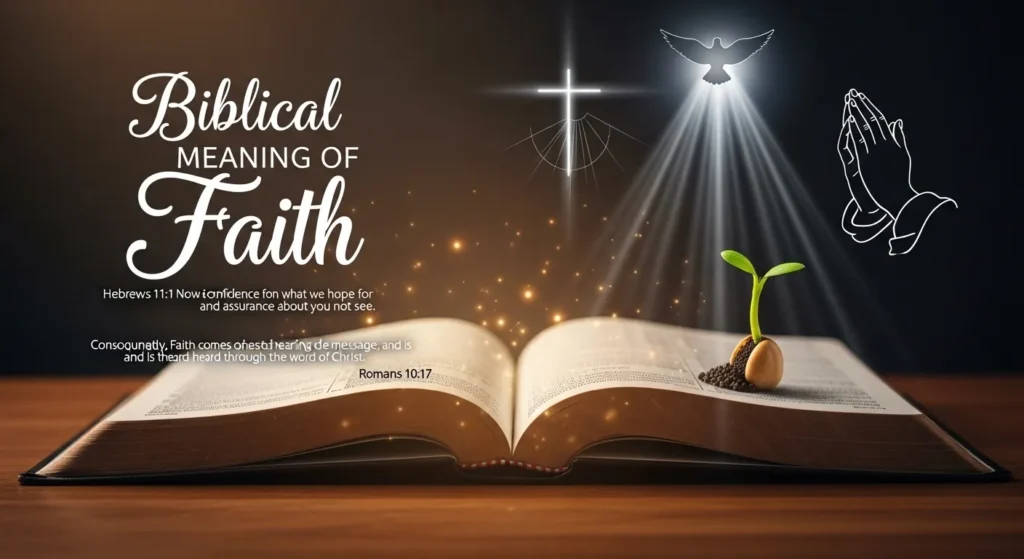
Faith is mentioned throughout the Bible as the foundation of a Christian life. Hebrews 11:1 (NLT) explains it beautifully:
“Faith shows the reality of what we hope for; it is the evidence of things we cannot see.“
This verse reveals that faith is more than wishful thinking. It is trusting God’s promises even when circumstances seem impossible. Abraham’s story is a classic example (Genesis 15:6). Despite being old and childless, he trusted God to fulfill His promise of a son. His faith made him righteous in God’s eyes.
Faith in the Bible often comes with hope, courage, and action. James 2:17 reminds us:
“Faith by itself is not enough. Unless it produces good deeds, it is dead.“
This teaches that true faith is aliveit shows itself in how we live, love, and respond to God’s guidance. It’s about believing and stepping forward, even when we cannot see the full path.
Faith also carries warning meanings in the Bible. When we doubt or neglect God’s promises, we may feel unsettled, anxious, or distant from His presence. The story of Peter walking on water (Matthew 14:28–31) illustrates this: he began with faith but faltered when fear and doubt took over. The lesson is clearfaith must be anchored in trust, not in circumstances.
The Bible encourages us to hold onto faith during trials, knowing that it brings peace, joy, and divine direction. Romans 10:17 says:
“Faith comes from hearing the message, and the message is heard through the word of Christ.“
By engaging with Scripture, praying, and reflecting, our faith deepens and becomes a guiding light through uncertainty.
Spiritual Significance and Symbolism
Spiritually, faith represents a bridge between human weakness and God’s strength. It is the invisible hand that lifts us when life feels heavy. In many Christian traditions, faith is symbolized by seeds, lamps, or riverssmall beginnings that grow into light, nourishment, and life.
Faith teaches patience and trust. For example, when waiting for answers in prayer, faith allows us to remain calm, believing that God’s timing is perfect. It is a reminder that even when we cannot see, God sees all, and His plan is always good.
Daily life offers countless opportunities to practice faith. Offering forgiveness, helping a neighbor, or praying without immediate results are all acts of living faith. Each small act strengthens our relationship with God and invites His presence into ordinary moments.
Faith also connects to spiritual transformation. Just as a caterpillar becomes a butterfly, our faith shapes our hearts, minds, and actions. It nurtures hope, resilience, and divine guidance, helping us grow into the people God intends us to be.
Biblical Interpretations in Dreams or Real Life
Faith often manifests in dreams or real-life experiences as light, warmth, or gentle guidance. Seeing a candle or a beam of sunlight in a dream may symbolize God’s reassurance, calling you to trust Him. Conversely, feeling lost or overwhelmed in dreams can reflect areas where faith needs to grow.
In real life, faith can appear in subtle ways: a quiet conviction to make a difficult choice, a sudden peace during a storm, or a moment of clarity after prayer. These experiences remind us that faith is active, living, and deeply personal.
Different scenarios carry different meanings:
- Peaceful settings: Divine approval, hope, and protection.
- Stormy or fearful moments: A call to strengthen trust and surrender to God’s plan.
No matter the situation, faith is always a source of comfort, pointing us toward prayer, reflection, and God’s wisdom.
Practical Lessons & Faith Insights
- Trust in God’s timing: Faith grows when we wait patiently.
- Act in love and service: Faith is alive when expressed in good deeds.
- Pray and reflect daily: Invite God’s guidance into every decision and challenge.
By practicing these, your faith becomes a living force that shapes your journey and strengthens your hope.
Conclusion
Faith in the Bible is more than beliefit is trust, hope, and action rooted in God’s promises. It guides us through uncertainty, transforms our hearts, and connects us to His divine presence.
As you reflect on your life and dreams, remember: faith is the light that never fades, even in darkness. Keep praying, trusting, and walking in His ways, and you will experience the peace, hope, and guidance that only God can give.
Discover More Articles
- Grace in Bible Meaning : Message,& Mercy Explained (2026)
- Mercy in the Bible Meaning: Definition, Examples, & Lessons
- Humility in the Bible Meaning : Definition, Lessons, & Power